Dementia (most commonly Alzheimer’s) affects almost 1 million people in the UK in 2024 and is projected to reach 1.4 million by 2040. Sleep problems affect around 1 in 5 people with dementia living at home — so safe, consistent overnight care is often essential. Dementia Statistics Hub+1
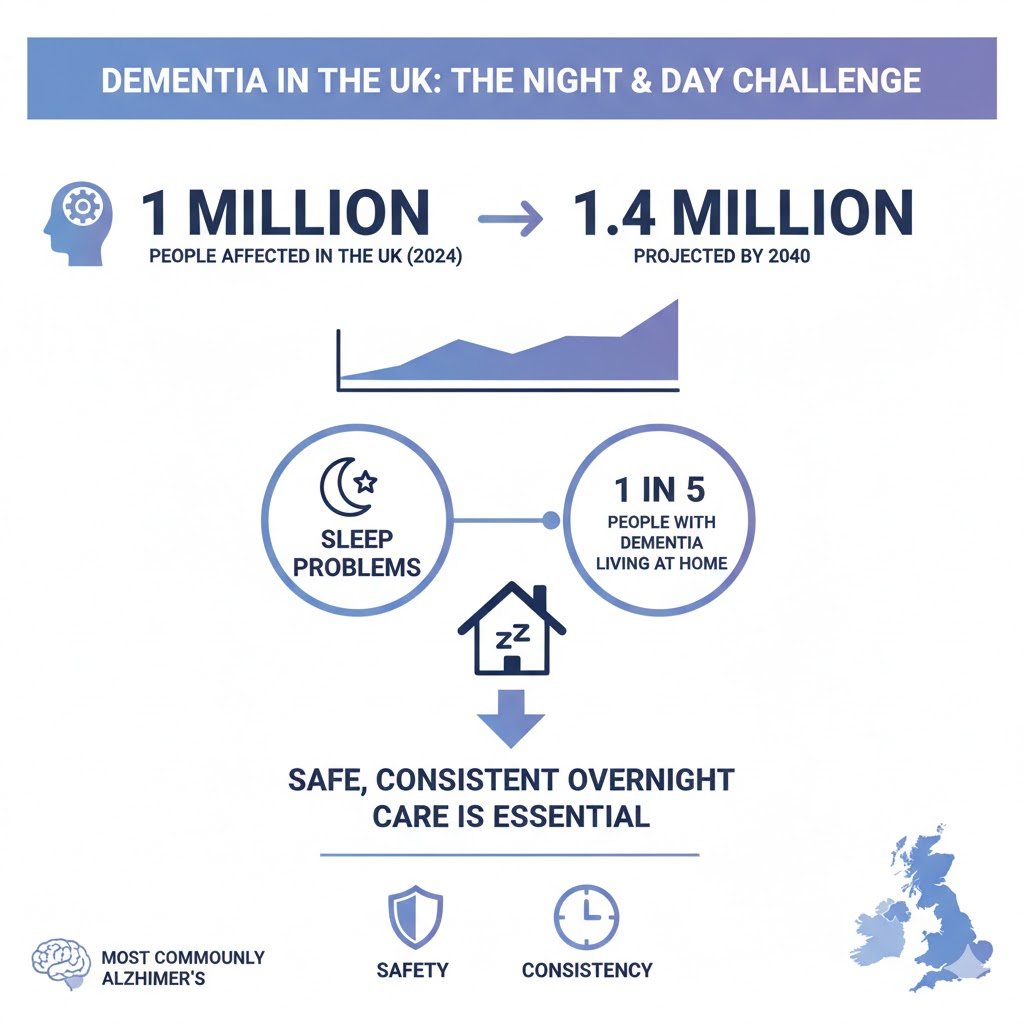
Table of contents
- Introduction — a short story
- Why overnight care matters (the data)
- Types of overnight care (what’s available)
- Practical overnight-care plan for home (step-by-step)
- Safety checklist for night-time dementia care
- Costs, funding & local support in Norwich / Norfolk
- How to choose a night carer or service
- Tips for carers (rest, resilience, records)
- Frequently asked questions (FAQs)
1. Introduction — a short story
When Ann first moved her father, john, back to Norwich after a short hospital stay, nights were the hardest. John would wake, confused and frightened, sometimes trying to get out of bed at 3 a.m. Ann slept with one ear open, terrified he might fall. After a week she booked a specialist night carer for a few nights a week. The first night the carer sat quietly in the kitchen, only stepping in when john called; by morning Ann had slept solidly for the first time in months. The household mood changed — less fear, better memory for daytime routines, and a clear plan for the nights ahead. This is the change overnight care aims to give families across Norwich and Norfolk.
2. Why overnight care matters
- Scale of the problem: Around 982,000 people were living with dementia in the UK in 2024, and numbers are rising (projected 1.4 million by 2040). Effective home-based care will be increasingly important. Dementia Statistics Hub+1
- Local picture (Norfolk / Norwich): Dementia prevalence in Norfolk among people aged 65+ was estimated at about 7.4% in 2020, slightly above national averages — indicating strong local demand for dementia services. north-norfolk.gov.uk+1
- Night-time symptoms are common: Systematic reviews estimate clinically significant sleep disturbance in people with dementia at ~19% (range across studies). Night-time agitation, wandering and toileting needs are frequent reasons families seek overnight care. ScienceDirect
- Carer impact: Family carers frequently report sleep loss and anxiety; poor sleep in carers is associated with worse physical and mental health. National surveys report large numbers of carers providing night-time supervision or coping with disrupted sleep. carersuk.org
3. Types of overnight care (what’s available)
- Family care / informal supervision
- Family member stays awake or light-sleeps to respond to calls. Low cost but high personal toll and unsafe long-term.
- Sleeping-night carer
- Carer sleeps in the home, wakes as needed. Best when risk is moderate and mostly reassurance/toileting needed.
- Waking-night carer (awake night shift)
- Carer is awake the whole night, actively supervising — appropriate for frequent wandering, high fall risk or complex needs.
- Short overnight visits
- Carers visit at night (e.g., twice per night) rather than staying. Cheaper but may miss crises.
- Technology plus monitoring
- Bed sensors, door alarms, movement sensors and telecare can reduce risk but should not replace a person when complex needs exist.
4. Practical overnight-care plan for home (step-by-step)
Step 1 — Risk assessment (first 48 hours)
- Note patterns: times when patient wakes, triggers (toilet needs, thirst, night lighting). Record any falls or exits. Share this with professionals.
Step 2 — Decide care level
- Low risk → sleeping carer or sensors.
- Moderate/high risk (wandering, frequent toileting, confusion) → waking-night carer.
Step 3 — Create a simple night routine
- Fixed evening meal time, toilet before bed, calming activities (quiet music, photo album), dim lights 60–90 minutes before sleep.
Step 4 — Environment and safety
- Night-lights in corridors, remove small rugs, install grab rails, secure external doors, use door alarms if wandering risk.
Step 5 — Medication & hydration plan
- Review medications with GP for night-time side effects. Keep a chart: medication, PRN (as-needed) doses, time last given.
Step 6 — Emergency plan
- Phone numbers (GP, out-of-hours NHS, local ambulance), key safe location, nearest neighbour/relative contact.
Step 7 — Monitor & review weekly
- Keep a 7-day sleep/behaviour log. Adjust staffing or technology after a 2-week review.
5. Safety checklist for night-time dementia care
- Clear pathways and night-lighting
- Bed and floor free from trip hazards
- Door alarm or monitored exit system if wandering risk
- Carer briefed on triggers and calming techniques
- Easy-reach cup of water and toileting aids
- Written med chart and consent documentation
- Backup contact who can arrive within 30–60 minutes
6. Costs, funding & local support in Norwich / Norfolk
Typical costs (UK guidance & market averages):
- Sleeping-night carers: can range widely; some agencies quote approx. £13–£20 per hour for night care or packaged nightly rates of £100–£240 per night depending on whether the carer sleeps or stays awake and on complexity. Local agency rates vary; request clear hourly breakdowns. Prime Carers+2Nurses Group Homecare+2
Funding options to explore:
- NHS and local authority assessments: A social-care needs assessment by Norfolk County Council or local Adult Social Care may identify eligible funded help or a partial contribution. Norfolk has local dementia resources and strategies—start with the county council / local NHS memory services. Norfolk and Norwich University Hospital+1
- Attendance Allowance / Disability benefits: People with dementia may qualify for Attendance Allowance (UK), which can help pay for overnight support. Check eligibility and apply early. (Confirm current thresholds and application process on GOV.UK.) GOV.UK
Local support in Norwich / Norfolk:
- Norfolk has specific dementia briefings and local carer support groups; the Norfolk Dementia Partnership and NHS memory services run programmes and advice for carers in the region. Ask your GP for referral to memory services and to local carer-support teams. norfolkinsight.org.uk+1
7. How to choose a night carer or service
Checklist when interviewing agencies / carers
- Proof of DBS (background) check and references.
- Dementia-specific training (e.g., understanding sundowning, communication).
- Written contract with duties, hours, notice period and emergency procedures.
- Clear charges (overnight rates, travel time, sleep vs waking night).
- Liability insurance and safeguarding policy.
- Trial night or phased introduction (start with a single night or two).
Questions to ask the carer
- Experience with Alzheimer’s specifically?
- How would you handle night agitation? (listen for techniques).
- Can they follow a personalised sleep/medication chart?
- Will they complete a night log for family review?
8. Tips for carers (rest, resilience, records)
- Share nights: rotate with another family member or use respite nights to avoid burnout.
- Protect your sleep: carers need recovery sleep — consider using two nights on/two nights off where possible.
- Record-keeping: brief night logs (time called, intervention, response) are gold — they help GPs and memory clinic reviews.
- Seek peer support: join local carers groups; Carers UK offers online resources and local groups. carersuk.org
9. FAQs
Q1 — When is a waking-night carer essential?
A waking-night carer is essential if the person wanders frequently at night, attempts unsafely to leave the home, has repeated falls or needs frequent repositioning or toileting every night.
Q2 — Can technology replace a night carer?
No. Sensors and alarms are valuable as supplementary tools, but they are not a replacement when the person has frequent disorientation, falls risk, or complex care needs.
Q3 — Will the NHS pay for overnight carers?
Funding depends on a social-care needs assessment. The NHS sometimes funds short-term support linked to rehabilitation; most long-term domestic overnight care falls under local authority social care or self-funded arrangements. Start with a needs assessment from Norfolk County Council and a GP/memory service referral. Norfolk and Norwich University Hospital+1
Q4 — How long does it take to stabilise night-time behaviour?
Changes can be seen within 2–4 weeks with consistent routines, medication review, and environmental adjustments. Keep a sleep/behaviour diary to track progress.
Q5 — Where can I find trusted local night-care providers in Norwich?
Ask the GP or memory clinic for recommended home-care agencies, check Norfolk County Council directories, and request references. Local carers’ groups and the Norfolk Dementia Partnership can recommend vetted providers. Healthwatch Data+1